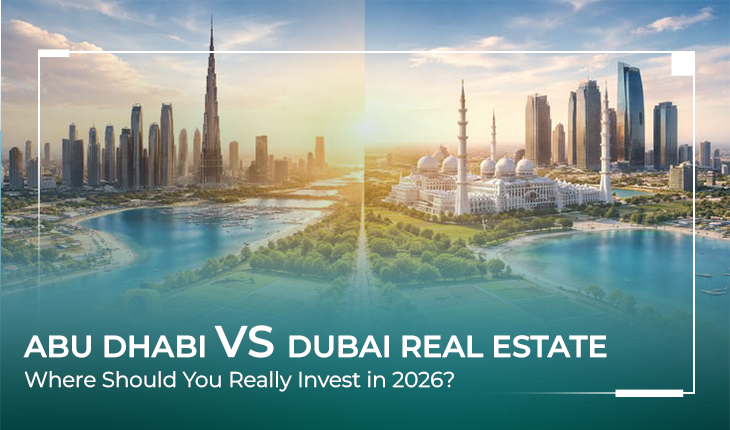
If you’ve spent any time researching property investment in the UAE, you’ve probably felt the pull of Dubai. The skyline is iconic, the off-plan launches are relentless, and the marketing machine behind it is unlike anything else in the region. But here’s a question worth sitting with: Is the loudest market always the smartest one?
At Gravity Real Estate, we work with investors every day who have already made up their minds about Dubai — and leave with a very different perspective on Abu Dhabi. Not because Abu Dhabi is the underdog trying to compete, but because the two markets are built for fundamentally different goals. And in 2026, that distinction has never been clearer.

Two Markets, Two Philosophies
Let’s start with the honest version of this comparison. Dubai and Abu Dhabi don’t actually compete for the same investors. They serve different needs, attract different buyers, and reward different types of thinking.
Dubai is a growth market. It moves fast, rewards risk-takers, and generates some of the highest rental yields in the world — often between 7 and 10 percent in the right areas. Over the past two years alone, the emirate recorded upwards of 217,000 off-plan transactions. That kind of volume signals a liquid, active market where buying and selling can happen quickly, and where capital appreciation can be significant.
Abu Dhabi is a stable market. Transaction volumes are lower — around 16,300 deals over the same period — but that number reflects something important: a market that isn’t chasing volume for its own sake. Development here is deliberate. Supply is managed carefully. And the result is a market where the fundamentals of supply and demand remain genuinely balanced.
In simple terms: Dubai gives you speed. Abu Dhabi gives you security.

Who’s Actually Buying — and Why It Matters
The type of investor each market attracts tells you a lot about what you can expect as a landlord or property owner.
Dubai draws international buyers, short-term investors, digital nomads, and high-net-worth individuals who are comfortable with volatility in exchange for higher returns. There’s nothing wrong with that approach — but it creates a market that’s more reactive. When global sentiment shifts, Dubai feels it. In March 2026, regional uncertainty caused a notable dip in transaction activity, with some developers offering discounts of up to 15 percent to move inventory. That’s the other side of a high-return market.
Abu Dhabi attracts a quieter but arguably more reliable buyer and tenant base: families settling for the long term, government employees, corporate residents on multi-year contracts, and conservative investors who measure success over a decade rather than a quarter. These tenants renew leases, pay on time, and rarely disappear overnight. For a property owner, that consistency has real financial value.

The Oversupply Problem Dubai Can’t Ignore
One of the most significant shifts in the 2026 UAE property landscape is the growing oversupply pressure in Dubai. Years of aggressive project launches have pushed new inventory into the market faster than it can be absorbed in certain segments. This doesn’t mean Dubai is collapsing — far from it — but it does mean the era of buying anything in Dubai and watching it appreciate is probably behind us. Location, timing, and developer track record now matter more than ever.
Abu Dhabi has largely avoided this problem. The emirate’s approach to real estate development has always been more controlled, and that discipline is paying off. Vacancy rates remain low, rental yields have held steady between 5 and 7 percent, and there’s no significant inventory glut creating downward pressure on prices. The market may not generate headlines, but it generates income.

So, Which Market Is Right for You?
The honest answer is: it depends on what you’re building.
If your goal is to flip a property within 12 to 18 months or to participate in a high-volume market with strong short-term upside, Dubai has genuine advantages. The liquidity is real, the exit options are plentiful, and the global name recognition helps at resale.
But if you’re building a portfolio designed to generate consistent rental income, protect capital during uncertain periods, and grow steadily over five to fifteen years, Abu Dhabi is hard to beat. The sovereign wealth backing, controlled supply environment, stable tenant base, and increasingly diversified economy all point toward long-term durability.
In our experience, the smartest portfolios don’t have to choose one or the other. Holding Abu Dhabi assets for income stability while selectively entering Dubai for growth is a balanced strategy that has served our clients well. But if you’re starting with a single investment and want to build from a position of confidence rather than speculation, Abu Dhabi is where we’d begin.

The Market That Rewards Patience
Markets don’t exist in a vacuum. The right investment isn’t the one with the most impressive numbers on paper — it’s the one that fits your timeline, your risk tolerance, and your actual financial goals. At Gravity Real Estate, we believe Abu Dhabi offers something increasingly rare in today’s property market: a place where steady, sensible investing still wins.
If you’d like to explore what that looks like for your specific situation, our team is here to help.
Gravity Real Estate — Abu Dhabi’s trusted partner for intelligent property investment.