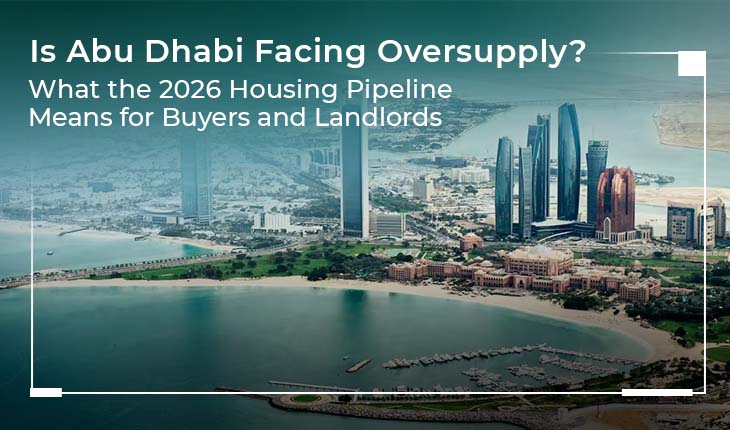
Every few months, a new headline asks whether Abu Dhabi’s property market is about to build too much, too fast. It is a fair question, and the answer matters if you are buying a home, planning an investment, or managing a rental. The latest figures from ADREC, Savills, and Cavendish Maxwell show a pipeline that is meaningful but staggered, not a sudden flood. Here is what the numbers say, and what we at Gravity Real Estate think they mean for you.
How Much Housing Supply Is Coming to Abu Dhabi, and When?
According to ADREC, Abu Dhabi’s residential stock stands at about 409,000 units and has grown by an average of 2.9% per year since 2022. The Abu Dhabi Region grew faster, at 3.3% annually, and holds 79% of the emirate’s stock.
Looking ahead, ADREC projects roughly 71,000 additional units by 2030, with deliveries peaking at around 21,800 units in 2028. Where that growth comes from matters too:
- Development projects will account for 77% of the Abu Dhabi Region’s supply growth between H2 2026 and 2030.
- Building permits will account for the remaining 23%.
- Nine major developers are behind 76% of the development pipeline.
So, the supply is concentrated in a handful of experienced names, and it arrives in waves rather than all at once.
Why Do the Supply Estimates Differ?
If you have seen different figures in different reports, you are not imagining it. Each source measures a different area and uses different assumptions:
- ADREC covers the whole emirate and expects about 71,000 units by 2030.
- Savills (Q3 2026) points to about 68,000 additional homes by 2030, concentrated in Saadiyat, Reem, Yas and Zayed City.
- Cavendish Maxwell (Q3 2026) covers Abu Dhabi City only and forecasts 14,600 homes in 2027 and 24,200 in 2028.
These numbers should not be added together or compared line by line. They describe different scopes, so the useful takeaway is the direction they share: more homes are coming, mostly between 2027 and 2028. Forecasts also move. Cavendish’s earlier report expected 17,300 units for 2027 and 26,000 for 2028, which is why we always read estimates as ranges.
How Often Do Handovers Slip?
This is the question most headlines skip, and it may be the most important one. Cavendish reports about 9,900 homes completed by the end of September, with 5,500 more scheduled by year-end. Based on past delivery rates, though, only 1,700 to 3,300 of those are likely to be ready on time.
Delays can come from construction costs, material sourcing and wider regional disruption, all of which Cavendish flags as risks. In practice, a scheduled handover date is a target, not a guarantee. That natural slippage spreads supply out over a longer period, which helps keep the market balanced.
Where Will the New Homes Be Built?
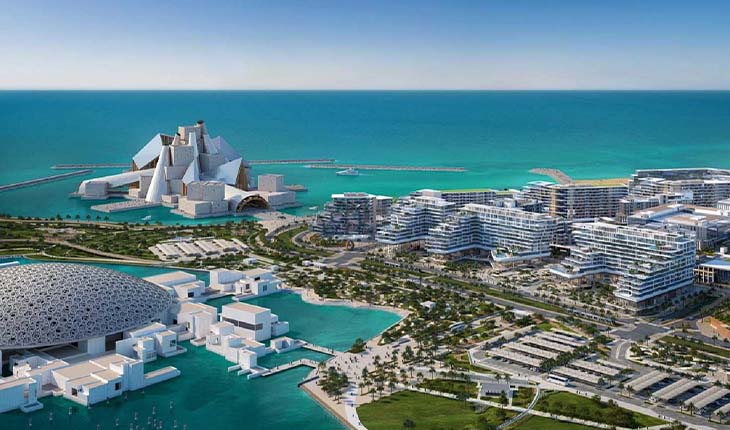
Supply will not land evenly across the emirate. Six districts will drive 77% of the incremental supply:
- Saadiyat Island
- Al Reem Island
- Yas Island
- Zayed City
- Khalifa City
- Hudayriyat
Investment zones already hold over 22% of stock, about 72,000 units, led by Reem at 27,500. For buyers, this is useful. Competition for tenants and resale buyers will be strongest within these districts, and quite different in areas with limited new supply.
What Are the Market Signals Telling Us So Far?
Early data does not point to a glut. It points to a market catching its breath:
- Cavendish Q3 recorded about 5,900 sales, down 7.5% year on year, yet total value rose to AED 26.4 billion. It describes the market as “more cautious.”
- ValuStrat Q3 reported freehold residential prices up 3.1% quarter-on-quarter, with apartments up 24% and villas up 10% year-on-year.
- ADREC shows residential sales reaching AED 70.4 billion, against AED 25.3 billion in H1 2025, with 61% of ready-market purchases paid in cash.
- Rents grew 3.5% for apartments and 1.8% for villas, slowed by the rent freeze, which cut the annual increase cap from 5% to 0%. Newly completed properties are exempt.
Fewer deals at higher values suggest buyers are becoming selective, not leaving.
What Does It Mean for Buyers and Landlords?
The honest conclusion is that this is a timing and location story, not a prediction of falling prices.
For buyers:
- Choose location and developer track record over headline discounts.
- Compare handover dates with a realistic delay buffer.
- Look at payment plans that match your cash flow, not just the price.
For landlords and investors:
- Expect more choice for tenants in the busiest districts, so presentation and pricing matter.
- Check whether your property falls under the rent freeze or qualifies as newly completed.
- Focus on quality and amenities, which keep a property rented when supply grows.
Should You Buy in Abu Dhabi Now? What the Supply Data Suggests
The data supports a measured view. Abu Dhabi is adding homes steadily, delivery rarely runs exactly to schedule, and demand is still strong. The sensible approach is to understand which district, which developer, and which delivery window you are dealing with.
If you are weighing a purchase or an investment, the team at Gravity Real Estate can help you read the market, compare projects across Saadiyat, Reem, Yas and beyond, and choose with confidence. Get in touch with Gravity today to talk through your options in the Abu Dhabi property market.